Structural Drying and Dehumidification in Grandville, MI
Extraction removes the liquid, but the building still holds water in studs, subfloors and block walls. Structural drying and dehumidification pull that moisture out until readings reach normal.
(888) 612-9219Plan structural drying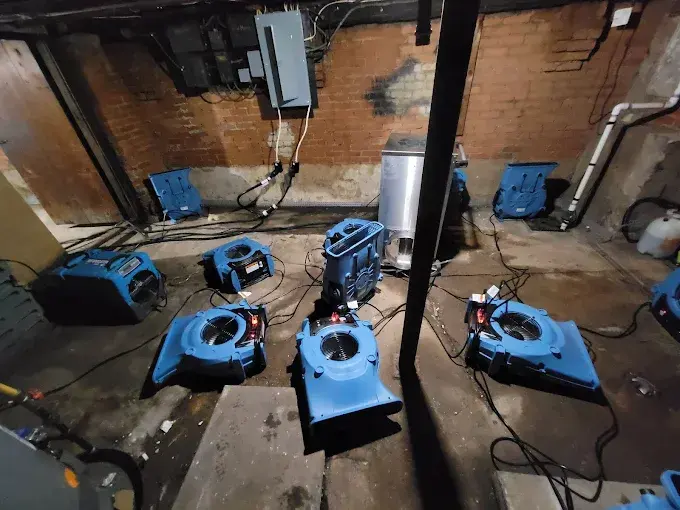
What to do right now about structural drying and dehumidification in Grandville
Structural drying starts after extraction and can last several days. It removes moisture that has soaked into framing, subfloors, plaster and block, using controlled airflow and dehumidification instead of heat or guesswork. The goal is a structure that is dry before it is closed up again.
Close doors and windows
Keeping the space sealed lets the dehumidifiers dry it efficiently.
Leave equipment running
Fans and dehumidifiers should not be switched off or moved around.
Report tripped breakers
Tell the crew if a unit shuts off or an outlet trips.
Keep the daily logs
Moisture readings and equipment notes back up the insurance claim.
How structural drying and dehumidification is handled in Grandville, MI
Assess and map
Meters and a moisture map set the class and equipment count.
Place the equipment
LGR units, air movers or desiccants go in for the water class.
Adjust daily
Readings decide which units move, which are added and which are removed.
Verify and remove
Equipment leaves when each material reaches its dry target.
What does structural drying and dehumidification cost in Grandville, MI?
Structural drying in Grandville runs $1,500 to $3,500 for Class 1 or 2 in a small area, $3,500 to $7,500 for Class 3, and $7,500 to $12,000+ for Class 4 dense materials.
Class 1 or 2, small area
- A handful of air movers
- One LGR dehumidifier
- Several days of logs
Class 3, basement or floor
- Walls and ceilings wet
- Several LGR dehumidifiers
- Daily equipment adjustments
Class 4, dense materials
- Block, slab, oak and plaster
- Desiccant drying units
- Extended monitoring
Ranges are typical, not a quote. For a planning number on your own loss, run the water damage cost calculator; the on-site walkthrough sets the real scope.
Classes of water loss
The IICRC S500 standard sorts losses by how much moisture the materials hold. Class 1 and 2 losses involve a small area or porous materials, Class 3 means walls and ceilings are wet from overhead water, and Class 4 involves dense materials such as block, slab, oak and plaster.
Equipment and daily adjustments
- LGR dehumidifiers pull water out of the air at low humidity.
- Air movers push dry air across wet surfaces and into cavities.
- Desiccant units handle dense materials that release water slowly.
Each day a technician takes readings, moves the equipment and removes units as rooms reach target. If readings stall, the setup is changed rather than left running unchanged.
After floods and sewage
Buildings that took on creek, river or sewage water need drying once the contaminated materials have been removed. The Brookcrest building on Wilson Avenue dried out in about three weeks after the April 2013 flooding, a reminder that large losses take time. See storm and flood cleanup, sewage backup cleanup and the Grandville hub.
How structural drying and dehumidification gets done to standard
Rapid local response
Wyoming water damage pros run 24/7 dispatch, and the response team treats standing water as urgent at any hour, holidays included.
IICRC S500 drying standard
The drying team follows IICRC S500, the industry drying standard: moisture mapping first, then structural drying, not just surface drying.
Claim-ready documentation
Each loss gets a moisture map, daily readings and timestamped photos, the file an adjuster reads before deciding a claim.
West Michigan water know-how
Block basements, sump pits, floor drains, frozen pipes and ice dams: local water damage experts know how water moves through a Kent County house.
Structural drying and dehumidification across Grandville and nearby communities
Structural drying covers Downtown Grandville, Buck Creek, Buck Creek South, Canaltown Woods, Carleton Park and Rivertown Place, with equipment set up across homes and businesses near Wilson Avenue and Chicago Drive in ZIP codes 49418 and 49468.
The same service nearby: structural drying and dehumidification in Wyoming, Grand Rapids, Walker.
Related water damage services in Grandville
Structural Drying and Dehumidification questions in Grandville, MI
Q01How long does structural drying take?
Three to five days is typical for a contained loss, longer for dense materials or large areas. Daily readings, not a fixed schedule, decide the finish.
Q02Why are the dehumidifiers so loud?
They move large volumes of air and run continuously. The noise is the sound of the building drying, and equipment is turned off as soon as materials reach target.
Q03Can wet drywall be dried in place?
Sometimes. Clean-water drywall that has not swollen or softened can often be dried through small openings, while sewage or flood-soaked drywall is removed.
Q04What is LGR equipment?
Low grain refrigerant dehumidifiers remove moisture even when the air is already fairly dry, which makes them efficient for finished basements.
Q05How do readings prove it is dry?
Meters compare wet materials to dry reference points from the same building. The logs document each day of progress for the insurance file.
Q06Does drying increase the electric bill?
Equipment draws power for several days, and the claim may cover part of it. Documenting the equipment count and run time helps.
Wet walls after the water is out?
A drying technician is assigned to map the moisture, set the equipment and log readings each day.
(888) 612-9219Ask about drying