Structural Drying and Dehumidification in Wyoming, MI
Water that soaks into framing, subfloor, block and concrete stays there long after the floor looks dry. The drying team sizes equipment to the load and tracks readings until the structure is dry.
(888) 612-9219Need the structure dried right? Call now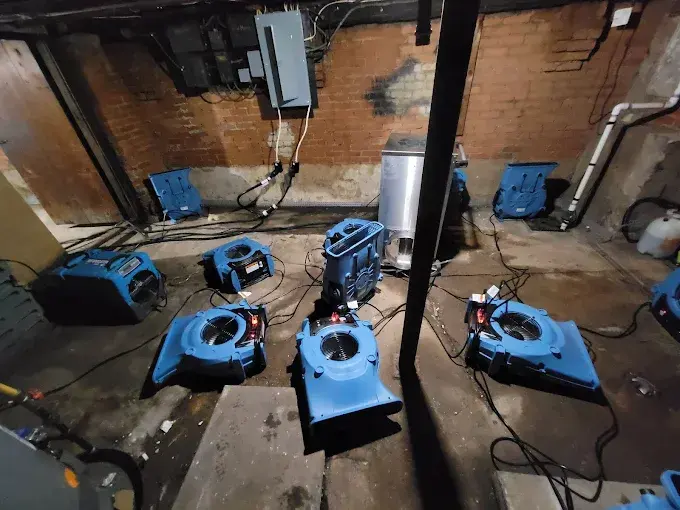
What to do right now about structural drying and dehumidification in Wyoming
Structural drying is the part of a water loss that cannot be seen. Drywall, studs, subfloor, block foundation walls and a basement slab all soak up water, and if they are closed up wet, the problem shows up later as odor, swelling and mold. In a Wyoming basement, the block and the slab hold the most water of all.
Get the water out
Extraction comes before any drying equipment goes down.
Open up the space
Move furniture and stored items so air can reach walls and floors.
Keep the heat steady
Leave the furnace or AC running unless the crew says otherwise.
Do not close it up
Hold off on new drywall or flooring until readings say dry.
How structural drying and dehumidification is handled in Wyoming, MI
Classify the loss
Category and class set the equipment plan for each room.
Set the equipment
Air movers and dehumidifiers go in at the evaporation load.
Log every day
Psychrometric and material readings are recorded and equipment adjusted.
Hit the drying goal
Equipment comes out at 2 to 4 points of a dry reference.
What does structural drying and dehumidification cost in Wyoming, MI?
In Wyoming, MI, structural drying typically runs $1,500 to $12,000, depending on the square footage, the class of loss, how many days the equipment runs and whether desiccant drying is needed for dense materials.
Class 1 or 2, small area
- A few air movers
- One LGR unit
- Three days of logs
Class 3, basement or floor
- Walls and ceilings wet
- Several LGR units
- Daily adjustments
Class 4, dense materials
- Block, slab, oak, plaster
- Desiccant drying
- Extended monitoring
Ranges are typical, not a quote. For a planning number on your own loss, run the Wyoming water damage cost calculator; the on-site walkthrough sets the real scope.
How structural drying is planned
The drying team classifies the loss from Class 1 (little water, low-porosity materials) to Class 4 (dense materials like oak, plaster, block and concrete). The class sets how many air movers go in and how much dehumidification the room needs.
- Air movers set to the room's evaporation load
- LGR dehumidifiers for most losses
- Desiccant units for Class 4 materials and cold basements
Psychrometrics and daily structural drying readings
Every day the drying team records temperature, relative humidity and grains per pound inside and outside the drying area, plus readings on the wet materials. Equipment is moved and adjusted as areas dry. Drying is done when wet materials read within 2 to 4 points of a dry reference material in the same house.
Winter and summer drying in Wyoming
Dry winter air with the furnace running helps drying; humid July air works against it, and a cold basement slows LGR units, which is when desiccants earn their place. The EPA indoor air quality pages explain humidity and moisture indoors, and the MSU Extension covers home moisture topics for Michigan.
How structural drying and dehumidification gets done to standard
Rapid local response
Wyoming water damage pros run 24/7 dispatch, and the response team treats standing water as urgent at any hour, holidays included.
IICRC S500 drying standard
The drying team follows IICRC S500, the industry drying standard: moisture mapping first, then structural drying, not just surface drying.
Claim-ready documentation
Each loss gets a moisture map, daily readings and timestamped photos, the file an adjuster reads before deciding a claim.
West Michigan water know-how
Block basements, sump pits, floor drains, frozen pipes and ice dams: local water damage experts know how water moves through a Kent County house.
Structural drying and dehumidification across Wyoming and Kent County
Wyoming Water Damage Restoration covers ZIP 49509, 49519, 49548, from Wyoming Park and the Godfrey-Lee blocks near Chicago Drive to Godwin Heights, the Rogers Plaza area and the newer streets off Byron Center Avenue along Buck Creek.
Nearby coverage reaches Grandville, Grand Rapids, Kentwood, Walker, East Grand Rapids, Byron Center, Jenison.
Related water damage services in Wyoming
Structural Drying and Dehumidification questions in Wyoming, MI
Q01Why not just open the windows and run fans?
Fans move wet air around; they do not remove the water. Dehumidifiers pull it out of the air so the structure can keep releasing it.
Q02What is a dry reference?
A reading on the same kind of material in an unaffected part of the house. Wet materials are dry when they read close to it.
Q03What is the difference between LGR and desiccant drying?
LGR dehumidifiers chill air to condense water; desiccants absorb it and work better in cold basements and on dense materials.
Q04How long does structural drying take?
Most losses take three to five days. Block, slab and hardwood can take a week or more.
Q05Is structural drying covered by insurance?
When the water loss is covered, drying is usually part of the claim, backed by the daily logs. Check with your own insurer.
Q06Can drying be done with people living in the house?
Usually yes. The equipment runs day and night and makes some noise, and rooms under sewage containment stay closed off.
Need a Wyoming house dried right? Call now.
Closing up wet framing and block traps the problem inside. The drying team dries the structure to readings and logs every day, 24/7.
(888) 612-9219Book Wyoming structural drying