Appliance and Supply Hose Leaks in Grand Rapids, MI
Washers, dishwashers, ice makers and refrigerator supply hoses can leak for days before anyone sees it. Grand Rapids crews trace the source and dry the floor, cabinets and walls.
(888) 612-9219Grand Rapids appliance leak help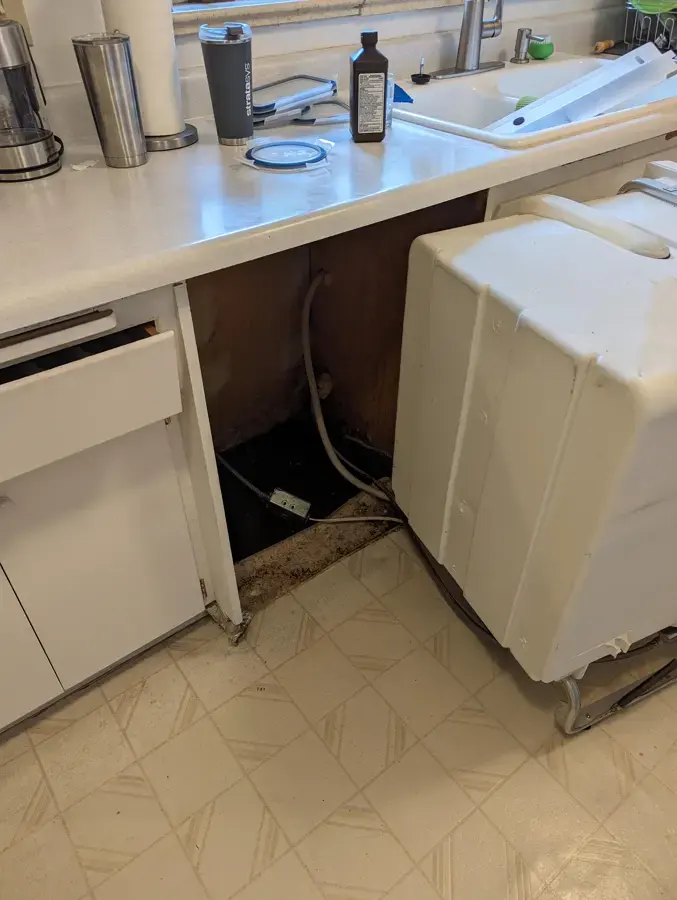
What to do right now about appliance and supply hose leaks in Grand Rapids
Washers, dishwashers and refrigerator ice makers leak in any home, and a slow drip can soak floors and walls before it shows. A brittle supply hose that lets go is the classic cause, and it can run until someone notices the damp.
Stop the appliance
Unplug it and close the supply valve behind or beside it.
Pull it out
If it is safe, slide the appliance away from the wall to expose the hose.
Soak up pooling water
Towels and a wet vacuum keep the water from creeping.
Photograph the damage
Capture the hose, the floor and anything stained.
How appliance and supply hose leaks is handled in Grand Rapids, MI
Trace
Meters find the leak path from the appliance outward, across floor, cabinet base and wall.
Open
Toe kicks and wet flooring edges come off so trapped water can escape.
Dry
Air movers and dehumidifiers dry the floor system.
Document
Photos and readings are saved for the claim.
What does appliance and supply hose leaks cost in Grand Rapids, MI?
Appliance leak cleanup usually costs $700 to $7,000 or more. A leak caught fast in one room costs less than a slow leak that soaked cabinet bases, subfloors and the ceiling below. Readings set the written estimate.
Caught fast
- One room of flooring
- Extraction and drying
- Readings until dry
Cabinets and subfloor
- Toe kicks removed
- Subfloor drying
- Ceiling below checked
Weeks of leaking
- Flooring removed
- Cabinet base opened
- Extended drying
Ranges are typical, not a quote. For a planning number on your own loss, run the water damage cost calculator; the on-site walkthrough sets the real scope.
Where the water hides
- Under vinyl, laminate and tile where water spreads sideways
- Inside cabinet bases and behind toe kicks
- Within the ceiling below when the leak is upstairs
A meter on the floor, cabinet base and wall shows how far the water went. Toe kicks come off, and flooring is lifted at the edge if water is trapped underneath. A leak from upstairs follows the steps in ceiling leak water damage.
Gray water and soap
Dishwasher and washer water carries soap and soil, so it is treated as gray water. Porous items that soaked are removed rather than dried, while sealed hard surfaces are cleaned and dried in place.
Slow leaks over weeks
A hose weeping slowly can soak a cabinet base and subfloor for weeks. Swollen particle board, soft flooring and staining show the longer history, and wood floors then follow the steps in hardwood floor water damage.
How appliance and supply hose leaks gets done to standard
Rapid local response
Wyoming water damage pros run 24/7 dispatch, and the response team treats standing water as urgent at any hour, holidays included.
IICRC S500 drying standard
The drying team follows IICRC S500, the industry drying standard: moisture mapping first, then structural drying, not just surface drying.
Claim-ready documentation
Each loss gets a moisture map, daily readings and timestamped photos, the file an adjuster reads before deciding a claim.
West Michigan water know-how
Block basements, sump pits, floor drains, frozen pipes and ice dams: local water damage experts know how water moves through a Kent County house.
Appliance and supply hose leaks across Grand Rapids and nearby communities
Appliance leaks are reported from Creston, Eastown, East Hills, Garfield Park and Roosevelt Park, in ZIP codes 49503, 49504 and 49506 as well as other Kent County neighborhoods, in homes of every size.
The same service nearby: appliance and supply hose leaks in Wyoming, East Grand Rapids, Walker.
Related water damage services in Grand Rapids
Appliance and Supply Hose Leaks questions in Grand Rapids, MI
Q01Which appliances leak most often?
Washers, dishwashers and refrigerator ice makers, usually from a worn hose or a loose fitting at the supply valve.
Q02How can a slow leak be found?
A moisture meter along the floor and cabinet base shows where water collects, even before stains appear or flooring starts to lift.
Q03Will the cabinets need to be replaced?
Solid wood bases often dry and stay. Swollen particle board usually does not recover and is removed.
Q04Does insurance cover appliance leaks?
Sudden leaks are commonly covered, but long term seepage can be excluded. Photos of the hose and moisture logs help show timing.
Q05Is the water clean?
Supply hose water starts clean, while drain hose water from a washer or dishwasher is gray. The category is noted at the start and decides what is removed.
Dry the floor, cabinets and walls
Call dispatch, name the appliance and the wet rooms, and a crew is sent with meters and drying equipment.
(888) 612-9219Send a leak crew