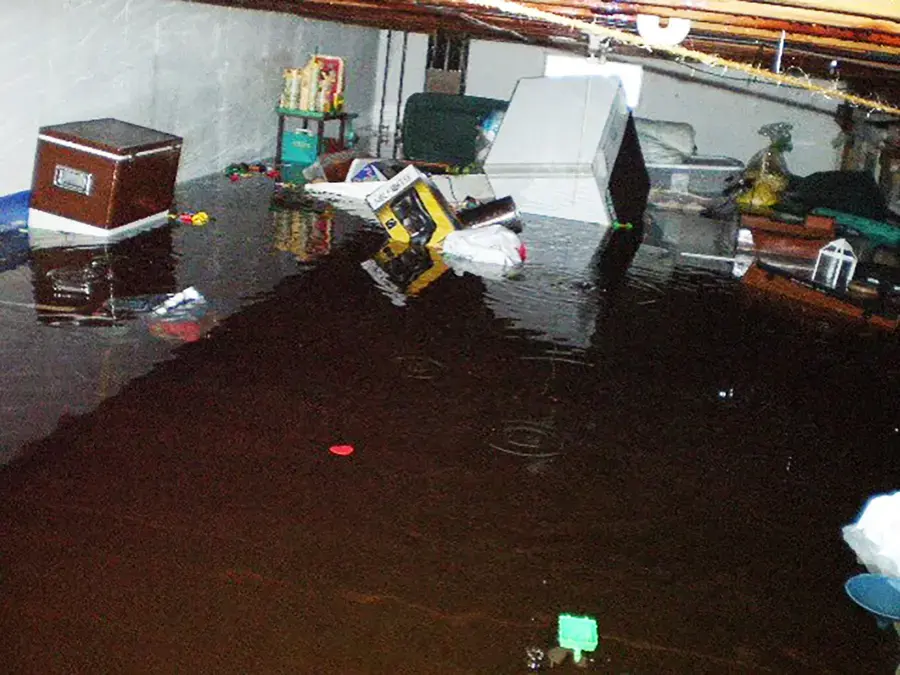
Wyoming grew up as a postwar suburb and became a city in 1959, and most of its houses are 1950s to 1970s ranches, bungalows and split-levels. Nearly all of them sit on a full or partial basement with block foundation walls. Block holds up well for decades, but it is not waterproof, and a wet spring or a hard summer storm shows exactly where water finds a way in.
Key takeaways
- Water enters block basements through mortar joints, the seam where the wall meets the slab, window wells and floor drains.
- A thin sheet of water along one wall usually points to groundwater, not a broken pipe.
- Spring snowmelt plus rain raises groundwater against basement walls, which is the season when seepage turns into standing water.
- Extraction comes first, then carpet and pad are pulled, wet drywall is cut, and the block and slab are dried with measured readings.
- A failed sump pump turns a damp basement into a flooded one, so the pump and its discharge pipe deserve a check before the wet season.
Why block foundation walls let rain water in
A block wall is a stack of hollow concrete units held together by mortar. Water pressing on the outside of the wall can move through the mortar joints, through the hollow cores and along the seam at the bottom.
A homeowner usually sees the result as a dark stain low on a wall, a white mineral crust or a damp strip along the edge of the floor.
The seam at the bottom of the wall
Where the slab meets the block there is a joint that was never sealed. When groundwater rises, it pushes up through that joint and spreads across the slab.
- Carpet and pad near that wall act like a wick and pull the water several feet into the room.
- Stored boxes and furniture legs on wet carpet soak up water and need to move out early.
Window wells and floor drains
Window wells fill in a downpour and can leak around the frame. Floor drains in older basements can also push water up when the ground around the house is saturated.
- A window well holding water or ice shows how much water sits against the wall.
- Water rising through a floor drain deserves a separate look, because it can carry sewage and is handled differently.
Buck Creek, spring melt and a high water table
Buck Creek runs north through Wyoming and reaches the Grand River at Grandville. In Grandville the creek has a NOAA and USGS gauge at Wilson Avenue, and at high stages the water overtops the Wilson Avenue bridge and reaches the bottom of the Chicago Drive bridge.
West Michigan adds lake effect snow and deep freezes in winter. When the snow melts and spring rain follows, groundwater rises against basement walls, and a block foundation takes the pressure at every joint.
The April 2013 flood shows the larger picture. Heavy rain sent the Grand River to a record crest of 21.85 feet at Grand Rapids on April 21, and the same month flooded basements across Kent County.
- Seepage tends to show up first along the low side of the lot, where runoff collects against the wall.
- A basement that stayed dry through one storm can still fail when the ground is already saturated from snowmelt.
- Creek flooding and groundwater seepage can happen in the same week, and both are cleaned up the same way once the water is on the slab.
What gets removed first after a basement floods
The order of work is the same in most basements. Standing water is pumped or extracted, wet materials that cannot be saved are taken out, and the structure is dried until readings match a dry reference.
An unfinished basement
A bare slab is pumped out and the block wall and slab are dried with daily moisture readings. A typical basement flooding cleanup for an unfinished basement runs $2,500 to $5,500.
- Pump-out of the slab and any low spots.
- Block wall and slab drying with fans and dehumidifiers.
- Daily readings until the wall and floor reach a dry reference.
A finished basement
When carpet, drywall and trim are involved, the price range moves up because more material has to come out. Clean water in a finished basement is commonly priced from $5,500 to $11,000.
- Carpet and pad removed, since pad does not dry in place.
- Flood cuts made a short height above the high water mark, and baseboards pulled.
- Low grain refrigerant dehumidifiers and air movers set across the room and moved as readings change.
- Block and framing behind the drywall checked, because wet block holds moisture longest.
When the sump pump is part of the problem
Aging sump pumps are a known weak point in Wyoming basements. A pump that burns out, loses power or sticks during a storm lets the pit overflow onto the slab, and the water follows the same path as groundwater seepage.
A sump pump failure cleanup follows the same steps as any basement flood. The difference is timing: the longer a pump stays down, the more carpet, drywall and wall base are lost.
- Pour water into the pit before the wet season and watch the pump start and stop.
- Check that the discharge pipe is clear and carries water away from the foundation.
- Keep stored items off the floor near the pit and the low wall.
- Know where the pit sits so it can be checked fast during a storm without wading into water.
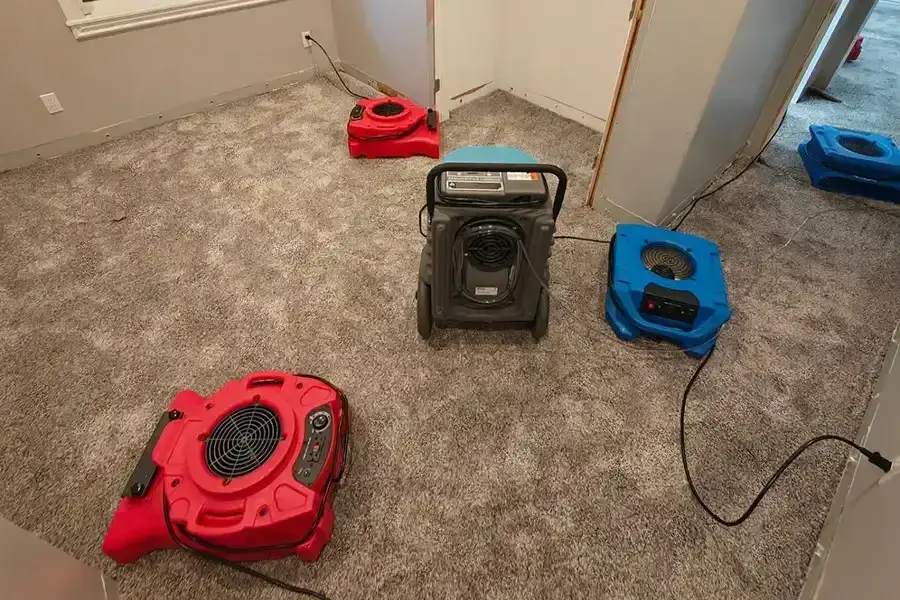
The first day after water reaches the slab
Safety comes before saving belongings. If water is deep enough to reach outlets, the power to the basement should stay off until it is checked.
The creek's lower reach is in Grandville, where a flooded basement follows the same plan as described here. See basement flooding cleanup in Grandville for how that work is handled across the city, and the Grandville service area for the neighboring towns.
- Photograph the water level, the wet walls and damaged belongings before anything moves.
- Lift furniture off wet carpet and move contents to dry rooms.
- Open windows only when the air outside is drier than the air in the basement.
- Ask the insurer whether groundwater seepage, sump pump failure and sewer backup are covered separately, since policies often split them.
- Call a restoration team early, because wet block and framing need structural drying that runs for days.
Questions
Why does a Wyoming basement leak along one wall after rain?
Water presses harder on the side of the house where the lot slopes toward the foundation, so that wall shows the seepage first. The water enters through mortar joints and the seam at the bottom of the block.
Is basement water from Buck Creek the same as groundwater?
The source differs, but the cleanup is the same once water is on the slab. Creek water that overtops its banks can carry silt and debris, which adds cleaning and sometimes treats the loss as contaminated water.
Can carpet in a flooded basement be dried in place?
Carpet can sometimes be saved if the water was clean and the loss is caught early. The pad underneath is usually removed, since it holds water and does not dry well.
How long does a block wall take to dry?
Block holds moisture longer than drywall, so drying often takes several days. The team keeps equipment running until readings on the wall and slab reach a dry reference.
Does homeowners insurance cover groundwater seepage?
Coverage varies by policy. Sudden pipe failures, sump pump overflow, sewer backup and groundwater are often treated differently, so the insurer should be asked which applies before the claim is filed.