
In February 2026 a freeze related water main break in Grandville flooded basements, and raw sewage backed up into some homes. The city said the break likely let water into a nearby sewer manhole, which contributed to the backups. A basement hit by both clean water and sewage is two problems at once, and the steps taken in the first day decide how much of it can be saved.
Key takeaways
- Water from a broken main is one problem, and sewage coming up a drain is another. Sewage is Category 3 and is handled with containment and protective gear.
- Stay out of a sewage affected basement, keep children and pets away, and stop using toilets, sinks and washers until the backup is cleared.
- The city's insurance provider found that the city did not meet the legal liability standard under state law after the February 2026 event, and told homeowners to use their own insurance or appeal.
- Photos, a written list of damaged items and the date of the loss support every claim route.
- Porous materials touched by sewage, such as carpet, pad and low drywall, are usually removed, not cleaned.
What happened in February 2026
A water main break near 30th Street and Wallace Street flooded basements in that part of Grandville. The city described the break as freeze related, and said it likely let water into a nearby sewer manhole.
That is how clean water became a sewage problem. When the sanitary system takes in more than it can carry, the weak point is the lowest drain in a house, which is often a basement floor drain or a laundry drain.
- Some homes in that area have finished basements with play areas and craft rooms, so more building material was exposed than in a bare utility basement.
- Grandville Public Works runs the city water, sanitary sewer and storm water systems, so main breaks and manhole concerns are reported to the city.
- The city has also posted main break notices on Honeywood Drive and on Wilson Avenue near Omaha, which shows that breaks happen in more than one part of town.
Clean water versus sewage in the same basement
Water that comes straight from a supply main is clean when it first escapes, but it picks up contamination fast once it spreads across soil, floors and stored items. Sewage is contaminated from the start.
A restoration team treats the two differently, even when they share one slab.
Clean water from a main or supply break
Clean water can often be extracted and dried in place if the loss is caught early. Carpet may be saved, though the pad is usually pulled.
- Water is pumped off the slab first.
- Walls and framing are checked with moisture meters before anything is closed up.
Sewage from a floor drain
Sewage is Category 3 water. It carries bacteria and cannot be cleaned out of porous materials, so those materials come out.
- Containment is set up so the contamination does not spread to clean rooms.
- Workers wear protective gear, and affected carpet, pad and low drywall are bagged and hauled out.
- Hard surfaces are cleaned and treated with antimicrobial products before drying starts.
The first day in a basement hit by a main break and a backup
The first priority is safety. Standing water in a basement can touch outlets, a furnace or a panel, so the power should stay off if water is near any of them.
- Do not run the washer, flush toilets or pour water down drains while sewage is coming up.
- Keep children and pets out of the affected area.
- Shut off the home's water at the main if a supply pipe may be involved.
- Photograph every wet area, the water level and the items that were damaged.
- Call a sewage backup cleanup team early, since contaminated material should not sit in a house.
Insurance after the city's finding
After the February 2026 flooding, the city's insurance provider found that the city did not meet the legal liability standard under state law. Homeowners were told to use their own insurance or appeal.
That makes the paperwork from the first day matter. Many homeowner policies treat sewer backup as an endorsement rather than part of the base coverage, so the policy should be read before any claim call.
- Ask the insurer whether sewer backup or water backup coverage was added to the policy.
- Keep receipts for hotel stays, cleanup and replacement items.
- Keep damaged items until the adjuster has seen them or approved disposal, and photograph them first.
- Keep the date and time the problem was first noticed, plus any notice from the city.
Boil water notices and what they change
When the city repairs a main, it can post a boil water advisory for the streets affected. The city has done this during repairs on Honeywood Drive and on Wilson Avenue near Omaha.
A notice like that covers drinking and cooking water. It is separate from the flood cleanup, but both can run in the same week, and a household under a notice should follow the city's instructions while crews work indoors.
More detail on sewage jobs is on the sewage backup cleanup page for the whole service area, and the Grandville service area lists the neighborhoods and ZIP codes covered.
- Check the city's notice for the streets and dates it covers before using tap water.
- Do not use tap water to rinse a sewage affected floor until the notice is lifted.
- Tell the restoration team about any advisory, since water for cleaning and mixing treatments matters.
How the cleanup is sequenced
A flooded finished basement is cleaned in a set order, because skipping a step spreads contamination or leaves water in the walls.
For a Category 3 loss in a finished basement, basement flooding cleanup is commonly priced from $11,000 to $20,000+, while a small backup on a bare floor sits nearer $3,000 to $6,000.
- Extraction of standing water and removal of contaminated carpet and pad.
- Cutting wet drywall above the high water mark and removing wet insulation.
- Cleaning and antimicrobial treatment of the slab and wall base.
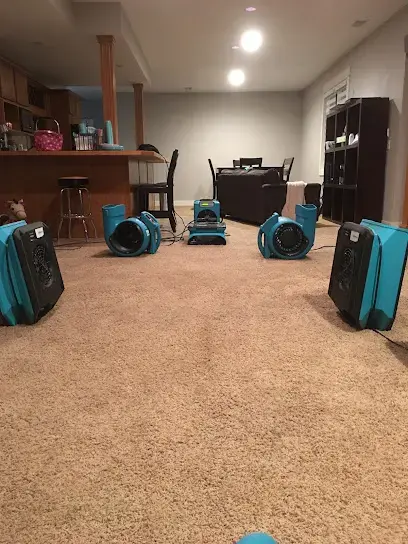
- Air scrubbing and drying with equipment adjusted daily.
- A final moisture check before any rebuild begins.
Questions
Is water from a broken main safe for a homeowner to clean up alone?
A small amount of clean water on a hard floor can be dried by a homeowner. Once water has soaked carpet, drywall or touched sewage, it is better left to a restoration team with extraction and drying equipment.
Why did sewage come up after a water main break?
In February 2026 the city said the freeze related break likely let water into a nearby sewer manhole. That added flow to the sanitary system, and the lowest drains in some homes took it.
Who pays for a sewage backup cleanup in Grandville?
After the February 2026 event, the city's insurance provider found the city did not meet the legal liability standard under state law. Homeowners were told to use their own insurance or appeal.
Can carpet touched by sewage be saved?
Usually not. Carpet, pad and low drywall that absorb sewage are removed because bacteria cannot be washed out of porous material.
How soon should cleanup start after a backup?
As soon as it is safe. Contaminated water spreads into walls and framing, so waiting increases the amount of material that must be removed.